Troodos Trip Planner: Wine Villages, Churches & Kykkos
Plan a Troodos trip village by village: the Commandaria wine route, ten UNESCO painted churches, Kykkos Monastery, where to stay and how long to spend.
The mountain heart of Cyprus
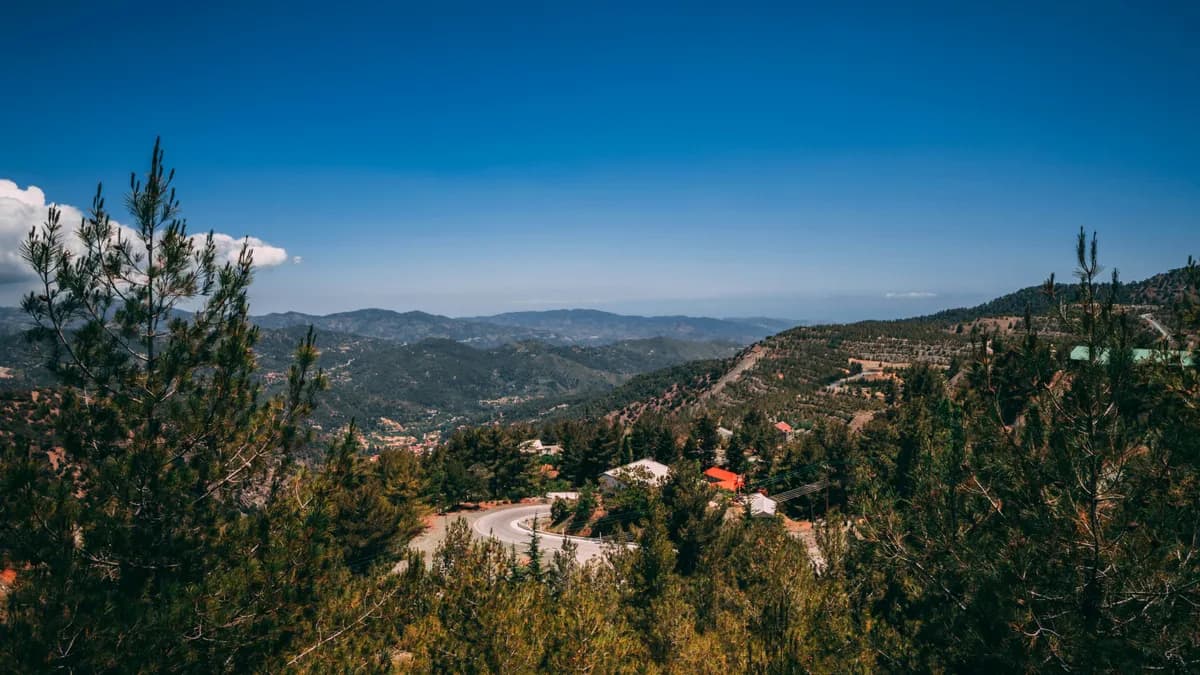
The Troodos mountains form the forested interior of the Republic of Cyprus, rising between Limassol on the south coast and Nicosia to the north. The range tops out at 1,952 metres on Mount Olympus, and the slopes are covered in black pine, cedar and golden oak. The air is noticeably cooler than the coast, which is why Cypriots have escaped here each summer for generations. Stone villages cling to the hillsides, Byzantine churches hide in the valleys, and small wineries press grapes grown above 600 metres.
The high ground around Mount Olympus is protected as the Troodos National Forest Park, roughly 90 square kilometres of protected pine forest with marked trails protecting river headwaters. You can reach the central villages in about an hour from Limassol or 50 minutes from Nicosia. Cyprus drives on the LEFT, and a hire car is the only realistic way to explore.
The hill villages
The villages are the reason most people climb into the Troodos. Each has a square, a coffee shop and a church, and many keep working trades such as wine or lace.
Omodos
Omodos sits at about 800 metres on the southern slopes, roughly 42 km northwest of Limassol. The cobbled main square fronts the Monastery of the Holy Cross (Timios Stavros), which holds a fragment of the True Cross and, by tradition, part of the Holy Rope said to have bound Christ, plus a relic venerated as the skull of the Apostle Philip. Legend says villagers repeatedly saw fire and smoke among the bushes and dug up a cave containing a cross, over which the first chapel was built. Small museums cover the national struggle, lacemaking and rural life, and the lanes hold wineries and lace shops. Read more in our Omodos village guide or join an Omodos wine tour.
Kakopetria
Kakopetria stands at about 667 metres in the Solea valley, its highest village, where the Kargotis and Garillis rivers meet to form the Klarios river. The old quarter has narrow stone paved lanes and restored houses with wooden balconies over the water. Its landmark is the Mylos tis Gonias, the Corner Mill, a watermill built in 1754 to grind wheat and barley, which stopped after the Second World War and has since been restored beside the first stone bridge. On Milos Street beside it, The Old Mill ties into that watermill history. Agios Nikolaos tis Stegis, one of the painted churches, sits about 5 km outside the village; see the Kakopetria page for more.
Platres
Platres (Pano Platres) sits higher, around 1,200 metres on the southern flank of Mount Olympus, about 9 km from Troodos and roughly 39 km from Limassol by road. It has been a hill resort since Britain took control of Cyprus in 1878, growing colonial era hotels in the early 1900s. New Helvetia, founded in 1906 with its building dating from 1929, is the oldest hotel in continuous operation in Cyprus. Forest Park Hotel, built in the 1930s, is where local history says Daphne du Maurier wrote part of "Rebecca" during a 1936 to 1937 stay. Platres straddles a perennial mountain stream, and its walk to the Caledonia and Millomeris waterfalls makes a good hiking base.
Pedoulas and the Marathasa valley
Pedoulas sits at about 1,100 metres in the Marathasa valley, roughly 75 km from Nicosia with a comparable drive from Limassol. It is Cyprus's main cherry growing area and hosts an annual cherry festival, usually in June, drawing thousands of visitors. Its Archangel Michael church, dated 1474, is one of the painted churches. Nearby Kalopanayiotis is known for stone houses, sulphur springs and a Venetian bridge over the Setrachos river.
The painted churches
The Troodos region holds ten small Byzantine churches and monasteries on the UNESCO World Heritage List as the Painted Churches in the Troodos Region: nine added in 1985, plus the church at Palaichori in 2001. From plain stone or timber exteriors, often with steep pitched roofs to shed snow, the interiors open into walls covered in frescoes painted between the 11th and 16th centuries. Highlights include:
- Asinou (Panagia Phorviotissa) near Nikitari, with some of the finest 12th century frescoes on the island
- Agios Nikolaos tis Stegis (St Nicholas of the Roof) near Kakopetria, named for its second protective roof
- Panagia tou Araka near Lagoudera, richly painted in 1192
- Archangel Michael at Pedoulas, dated to 1474
- The Monastery of Agios Ioannis Lampadistis at Kalopanayiotis, three churches under one large timber roof, believed founded in the 11th century
Several churches are kept locked, with a key holder usually living nearby and no fixed admission, though a small donation is expected, and photography is often restricted. Plan a route rather than expecting to see all ten in a day; pairing the Marathasa villages with Kalopanayiotis is one practical way to see several at once.
Kykkos Monastery
The Holy Monastery of Kykkos is the wealthiest and best known monastery in Cyprus. It stands at about 1,318 metres on the northwest side of the range, about 13 km from Pedoulas, letting you combine it with the Marathasa villages in one loop. Tradition ties its founding to Byzantine emperor Alexios I Komnenos, said to have sent an icon of the Virgin Mary to Cyprus after a hermit healed a member of his family; the monastery holds that icon, attributed to the Apostle Luke, and today's buildings are later work, since fire destroyed the original several times. Archbishop Makarios III, the republic's first president, began his career here as a novice.
Entry is free; the museum charges a small fee, commonly around EUR 5, subject to change. Typical hours, as of 2026, run 10:00 to 16:00 from November to May and 10:00 to 18:00 from June to October, open year round except public holidays. Modest dress is required, shorts are not permitted, and shoulders and knees must be covered; free cover up robes are available at the entrance. See the Kykkos Monastery page for details.
Mount Olympus and hiking
Mount Olympus, locally called Chionistra (Greek for snow), is the highest point in Cyprus at 1,952 metres. A British radar station occupies the summit itself, so you cannot stand on the very top, but the loop trail around it gives wide views over the forest and both coasts on clear days. See the Mount Olympus page for orientation. The forest park has ten marked trails totaling about 57.6 km. Signed routes near the summit and around Platres, part of Troodos mountain hiking, include:
- Artemis trail, easy, circling Olympus at roughly 1,850 metres, about 7 km, typically 2.5 to 3 hours
- Atalante trail, easy to moderate, a contour route from Troodos Square, around 14 km clockwise through pine and cedar forest, about 4 hours
- Caledonia trail, moderate, between Pano Platres and the Caledonia waterfall along the Kryos river, about 3 km one way, roughly 2 hours, with a steady uphill grade
- Millomeris trail, short but rated difficult, about 1.2 km one way from Pano Platres, with steep, rocky stretches, to a waterfall often called the tallest in Cyprus at about 15 metres, under an hour
Trails are best from April to June and September to November. Carry water, since taps are scarce, and wear proper shoes since paths are rocky. In a cold winter the upper slopes hold enough snow for a short ski season, run on four lifts across two zones, typically January to March (more below).
The wine villages and Commandaria
The southern slopes of the Troodos are the Krasochoria, the densest cluster of wineries on the island, growing indigenous Xynisteri (white) and Mavro (red) grapes up to around 1,000 metres. Omodos, Koilani, Vouni and Lofou belong to this wine belt, outside the narrower legal zone for the region's most famous product.
That product is Commandaria, an amber dessert wine made by leaving grapes to overripen on the vine, then sun drying them after harvest to concentrate the sugar before fermentation. A 1990 Cyprus law defined a protected zone of 14 villages entitled to the name, including Agios Georgios, Kalo Chorio, Doros, Laneia, Louvaras and Silikou, and it carries designation of origin status in the EU, the US and Canada. In December 2025, Commandaria was added to UNESCO's list of the Intangible Cultural Heritage of Humanity, Cyprus's seventh element on that list, and tradition traces it back millennia, including a legend it was served at Richard the Lionheart's wedding in Limassol in 1191.
You can tour the area on a Limassol wine villages tour, taste the sweet wine on a Commandaria tasting, or build your own loop through Omodos, Koilani, Vouni and Lofou; our weekend wine villages guide covers a longer route. Many small producers welcome visitors without booking, though calling ahead is wise outside summer.
Seasons in the Troodos
Summer is the main draw for anyone escaping the coastal heat: while Limassol and Larnaca sit in the low 30s Celsius (high 80s to low 90s Fahrenheit) through July and August, the higher villages run noticeably cooler. Spring and autumn bring the best hiking weather and clearest views, plus the cherry festival window in Pedoulas. Winter is genuinely cold at altitude and brings real snow most years, feeding the ski operation above; roads into high villages sometimes get restricted to vehicles carrying chains or four wheel drive during snowfall, so check road condition reports before a winter trip.
Practical driving and where to stay
Troodos roads are narrow and winding with sharp hairpins: drive slowly, use a low gear on descents, and sound the horn on blind corners, a habit locals still practice. Fuel stations are sparse once you leave the main towns, so fill the tank first. As of 2026, pump prices run roughly EUR 1.55 to 1.75 per litre for unleaded 95 and EUR 1.65 to 1.80 for diesel, currently pricier; cards are widely accepted but rural stations can be cash only. Most rental cars carry red plates, which makes them easy to spot as hire cars. Between November and March, snow and ice are a real possibility on higher roads.
A single day covers one valley comfortably: a village and a winery, one painted church, a short walk. Staying overnight lets you add a second valley and catch villages before day trippers arrive. The Cyprus Agrotourism Company, set up in 1996, represents more than 150 members, many traditional stone village houses renovated for guest stays. Kalopanayiotis, Kakopetria and Lofou have clusters of these, booking up during the cherry festival and summer weekends, so reserve ahead.
What to eat
Mountain cooking leans on slow roasting and the village oven. In Pano Platres, Psilo Dendro has run as a working trout farm and restaurant for more than 50 years, grilling trout from its own tanks for outdoor diners under the trees; it is primarily a warm season, lunchtime stop, so check ahead in winter. Village tavernas serve meze, small hot and cold dishes built around local lamb and pork with fresh bread and dips. Look for these specifically:
- Kleftiko, lamb sealed in a clay oven until it falls off the bone
- Souvla, large chunks of meat turned slowly over charcoal
- Halloumi, the grilling cheese, often served with village bread
Practical planning
| Detail | Information |
|---|---|
| Currency | Euro (EUR), card widely accepted, carry cash for key holders and small wineries |
| Getting there | Hire car from Limassol (1 hour) or Nicosia (50 minutes); driving is on the LEFT |
| Best months | April to June and September to November for hiking; January to March for a chance of snow |
| Emergency | 112 across Cyprus |
| Power | Type G plug, 230 to 240V |
| Language | Greek, with English widely spoken |
The Troodos pair well with the coast. Combine the mountains with Limassol for an easy two centre trip, or add the western valleys near Polis and Latchi. With only a day, focus on one valley: Omodos and a winery, one painted church, and a short walk near Platres.
Frequently Asked Questions
Do I need a car to visit the Troodos mountains?
Yes, effectively. Public buses reach some larger villages, but service is thin and not built around combining several stops in one trip. A hire car lets you pair a village, a church and a trail in a day, the only practical way to reach most trailheads.
How long does it take to drive from the coast to the Troodos?
From Limassol, the central villages are about an hour's drive; from Nicosia, around 50 minutes. Platres is roughly 39 km from Limassol, Kakopetria roughly 50 km, and Pedoulas roughly 75 km from Nicosia, so allow extra time for winding roads.
Can you still ski in the Troodos mountains?
Yes, when there is enough snow. The Cyprus Ski Club runs four lifts above Troodos Square across two zones, typically within a January to March window, but the season depends on snowfall each year and slopes can stay closed if conditions are insufficient.
Do you need to visit all ten painted churches?
No. The ten UNESCO painted churches are spread across the range rather than clustered, so seeing all in one trip is unrealistic. Pick two or three on your route, such as Agios Nikolaos tis Stegis near Kakopetria and the Archangel Michael church at Pedoulas, and save the rest for later.
What should I wear to visit Kykkos Monastery?
Modest dress is required for everyone: shorts are not permitted, and shoulders and knees must be covered. If you arrive under dressed, free cover up robes are available at the entrance, so it is not a reason to skip the visit.
Is Commandaria the same as the wine made in the krasochoria villages?
Not exactly. The krasochoria is the broader band of wine producing villages, including stops like Omodos and Koilani. Commandaria is a specific product legally tied to a narrower list of 14 villages defined by Cyprus law, so the two overlap but are not identical.
What is the best base for exploring the Troodos, Platres or Omodos?
Platres suits hikers and anyone chasing cooler summer air, since it sits higher and puts the Caledonia and Millomeris waterfalls within a short walk. Omodos suits a shorter visit focused on wine tasting, easy to reach and leave in half a day. Many visitors combine both.
Are the mountain roads safe to drive for a first time visitor to Cyprus?
They are manageable if you drive cautiously. The roads are narrow and winding with sharp hairpins, so keep your speed down, use a lower gear on descents, and sound the horn on blind corners as locals do. In winter, snow and ice are realistic, so check conditions between November and March.
Troodos Mountains
This guide covers Troodos Mountains. Explore more about this destination.
View DestinationAbout the Author
Alex Borshch
Founder and editor of the Isla365 network. Spent six months living in the Dominican Republic over the 2013-14 winter, and has since wintered in Thailand, Vietnam and Turkey. Writes and edits the guides across the network.