Things to Do in Cyprus: A Complete Guide
Things to do in Cyprus span UNESCO-listed Roman mosaic villas uncovered in 1962, the top-ten Zenobia wreck dive, Troodos trails and east-coast beaches.
Cyprus packs a lot into a small island. You can stand inside a Roman villa floored with 1,800-year-old mosaics in the morning, swim off a quiet cove at midday, and drink local wine in a mountain village by evening. The Republic of Cyprus (the government-controlled south) covers everything below, and most of the highlights sit within a 90-minute drive of each other. The country uses the euro, drives on the left, and runs on the EU emergency number 112. Greek is the official language, but English is spoken almost everywhere. Here is how to spend your time well.
See the ancient sites and mosaics
Cyprus has been settled, fought over, and rebuilt for thousands of years, and the archaeology is genuinely first-rate rather than a token stop. Start in the west.
The Paphos Archaeological Park at Kato Paphos has been on the UNESCO World Heritage List since 1980. Its four Roman villas, including the House of Dionysos, preserve some of the finest mosaic floors in the eastern Mediterranean, depicting mythological and hunting scenes. The first mosaics here were uncovered in 1962 by a farmer ploughing his field. A short walk away, the Tombs of the Kings is a necropolis of underground chambers cut straight into the rock, used by Paphos officials rather than actual royalty.
East of Paphos, near Limassol, Ancient Kourion sits on a cliff above the sea, with a Greco-Roman theatre still used for performances and more mosaic floors in the House of Eustolios. Nearby Kolossi Castle, a 13th-century Crusader stronghold, is tied to the production of Commandaria, the sweet dessert wine. In the south, Choirokoitia is a Neolithic settlement, also UNESCO-listed, where reconstructed round houses show how people lived here more than 9,000 years ago.
For Aphrodite mythology, Aphrodite's Rock (Petra tou Romiou) on the Paphos-Limassol road is the sea stack where the goddess is said to have risen from the foam. You can swim at the pebble beach below, listed separately as Petra tou Romiou beach.
Spend time on the beaches
The east coast around Ayia Napa and Protaras has the clearest, palest water and the most reliable sand. Nissi Beach is the famous one, with a sandbar you can wade across to a small islet. Fig Tree Bay at Protaras is calmer and good for families, and Konnos Bay sits in a sheltered horseshoe between the two towns. For something quieter, Sunrise Beach and Makronissos Beach spread the crowds out.
Further west, Coral Bay near Paphos is the main resort beach, while Lara Beach on the Akamas peninsula is an undeveloped stretch where loggerhead and green turtles nest. Finikoudes Beach runs along the Larnaca seafront in the middle of town, and Governor's Beach between Limassol and Larnaca has dark sand framed by white chalk cliffs.
Head into the Troodos mountains
The Troodos mountains are the green, cool centre of the island and a complete change of pace from the coast. Mount Olympus (Chionistra) is the highest point in Cyprus at 1,952 metres and holds enough snow in winter to support a small ski area on its Sun Valley and North Face slopes. The rest of the year it is a hiking base.
Several waymarked nature trails circle the upper slopes with long views, but they do not all begin in the same place: the 14 km Atalanti loop starts at Troodos Square, while the 7 km Artemis loop starts about 300 metres from where the Chionistra road meets the Troodos to Prodromos road. Serious walkers should look at Troodos mountain hiking for the full network. Within the Troodos National Forest Park you will also find painted Byzantine churches, ten of which are UNESCO-listed for their frescoes.
The mountains hold two of the island's most important monasteries. Kykkos Monastery, the wealthiest on Cyprus, is famous for its gold mosaics and an icon attributed to Saint Luke. Cap a mountain day at Omodos village, a stone wine village with a cobbled square, or push north to the remote Cedar Valley, home to thousands of native Cypriot cedars and the occasional mouflon (the island's wild sheep).
Drink the wine
Cyprus has one of the oldest wine cultures in the world, and the indigenous grapes (Xynisteri for whites, Mavro and Maratheftiko for reds) make it worth more than a single tasting. The villages on the southern slopes above Limassol are the heart of it.
- A Limassol wine villages tour links several small producers across the Krasochoria (literally "wine villages") in one trip.
- An Omodos village wine tour focuses on the most visitor-ready of those villages, with cellars off the main square.
- Commandaria wine tasting covers the sweet amber wine that has been made in the same region for centuries and is one of the world's oldest named wines still in production.
If your visit lands in late September, the Limassol Wine Festival in the Municipal Gardens is a long-running celebration with tastings and food, usually running for around ten days into early October. Read more on the regional Commandaria entry before you go.
Dive the Zenobia wreck
Off Larnaca lies one of the best wreck dives anywhere. The MS Zenobia, a Swedish-built roll-on roll-off ferry, capsized and sank in Larnaca Bay in June 1980 on her maiden voyage. She rests on her port side at around 42 metres, with the upper starboard side reachable from about 16 to 18 metres, and her cargo of articulated lorries is still chained on the decks. The Times and many dive publications rank her among the top ten wreck dives in the world.
Because the ship is so large, there is something here for every level, from guided dives for newly certified divers over the shallower hull to technical penetration dives through the car decks. Book through a Larnaca operator for scuba diving the Zenobia wreck; certification and a buddy check are standard. If you are not a diver, the rest of the coast still has plenty of accessible snorkelling.
Watch the wildlife and walk the coast
In winter the Larnaca Salt Lake fills with rain and draws thousands of greater flamingos, typically from November to March, with the biggest numbers between December and February. View them from the marked paths rather than approaching, and aim for early morning or late afternoon light. A salt lake flamingo birdwatching outing pairs the lake with the Hala Sultan Tekke mosque on its shore.
On the Paphos side, the Akamas peninsula is the wildest corner of the country. Lara Beach hosts a turtle conservation project, and you can join turtle watching at Lara in the nesting season. The Avakas Gorge nearby narrows to a slot you can walk through, and the Blue Lagoon at the tip is reached on foot, by 4x4, or on a Blue Lagoon boat cruise from Polis and Latchi. On the east coast, Cape Greco has sea caves, cliff paths, and a natural rock arch.
Take day trips between the towns
Distances are short, so basing yourself in one town and exploring the rest is easy. Here is a rough sense of driving times.
| From | To | Approx. drive |
|---|---|---|
| Larnaca | Nicosia | 45 minutes |
| Larnaca | Ayia Napa / Protaras | 45 minutes |
| Limassol | Troodos (Mount Olympus) | 1 hour |
| Limassol | Paphos | 1 hour |
| Paphos | Polis / Latchi | 40 minutes |
The capital, Nicosia, deserves a day for its Venetian walls and museums. A Nicosia old town walking tour of the old town covers the restored Ledra Street area and the Cyprus Museum's archaeology collection. From the east coast, a Cape Greco boat cruise reaches sea caves the road cannot, and families gravitate to WaterWorld waterpark in Ayia Napa. From Paphos, an Akamas jeep safari reaches the gorge, the Baths of Aphrodite, and remote bays in one trip.
Eat as you go
Cypriot food rewards grazing. A meze meal brings a long parade of small plates, and the staples are worth seeking out: grilled halloumi, slow-roasted kleftiko lamb, souvla (large cuts cooked slowly over charcoal), and loukoumades honey dumplings to finish. Order what the village around you is known for and you will rarely go wrong.
Quick planning notes
- When to go: April to June and September to October are the most comfortable. July and August are hot but reliable for the sea; winter suits the mountains, the wine villages, and the flamingos.
- Getting around: A hire car is the practical choice for the interior and the Akamas. Remember to drive on the left.
- Money: Cyprus uses the euro. Cards are widely accepted, but carry some cash for village tavernas and small producers.
- Essentials: Plug type G (the UK three-pin), 230 to 240 volts. Dialling code is +357. Emergency number is 112.
Frequently Asked Questions
How many days do you need to see the best of Cyprus?
Five to seven days covers the highlights well: two or three nights on the coast (Paphos or Ayia Napa/Protaras), a night or two in the Troodos mountains, and a day for Nicosia's old town. Ten days to two weeks lets you add the Akamas peninsula, a wine-village crawl, and the Zenobia dive without rushing.
Do you need a car to see the ancient sites and the Troodos mountains?
For the Troodos villages, the wine region, and remote spots like the Avakas Gorge and Cedar Valley, yes, a hire car is the practical choice since bus service thins out fast once you leave the coast. The main archaeological parks (Paphos, Kourion, Choirokoitia) and coastal towns are reachable by bus or organised tour if you would rather not drive, and Cyprus drives on the left.
Is Cyprus worth visiting if you don't want a beach holiday?
Yes. Between the UNESCO mosaics and Neolithic site, the painted Byzantine churches and monasteries of the Troodos, the wine villages above Limassol, and the Zenobia wreck dive, there is a full week of inland and cultural content that does not depend on the coast at all.
Do you need to be a certified diver to see the Zenobia wreck?
Yes. Introductory try-dive programmes (PADI Discover Scuba Diving, SSI Basic Diver) are capped at 12 metres, which is shallower than the highest point of the wreck, so the Zenobia itself is a dive for certified divers. Larnaca operators set their own entry bar, often Advanced Open Water or equivalent, and the deeper hull and car-deck penetration dives at around 42 metres need the relevant wreck and technical training on top of that.
What's the best month to combine Troodos hiking with beach time?
April, May, June, September and October give warm enough sea temperatures for swimming while keeping the mountain trails comfortable rather than baking. In peak July and August the coast is hot but reliable, while the Troodos altitude offers a cooler break from it; midwinter suits the mountains, the wine villages, and the Larnaca Salt Lake flamingos rather than the beach.
Pick two or three of these threads (ancient sites, beaches, mountains, wine, diving) rather than trying to do everything, and a week on the island feels generous rather than rushed.
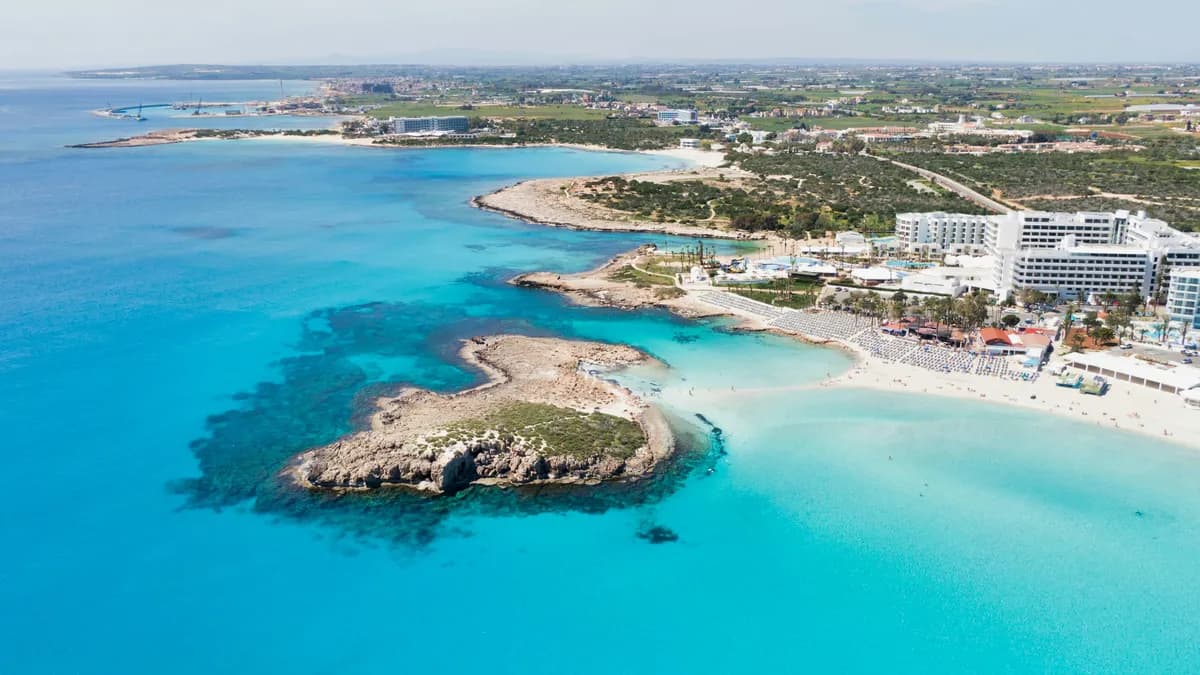
Ayia Napa
This guide covers Ayia Napa. Explore more about this destination.
View DestinationAbout the Author
Alex Borshch
Founder and editor of the Isla365 network. Spent six months living in the Dominican Republic over the 2013-14 winter, and has since wintered in Thailand, Vietnam and Turkey. Writes and edits the guides across the network.