Flamingos in Cyprus: When and Where to See Them (2026-27)
Flamingo season in Cyprus runs from about November to February. Larnaca versus Akrotiri, this winter's first counts, viewpoints, rules and what to bring.
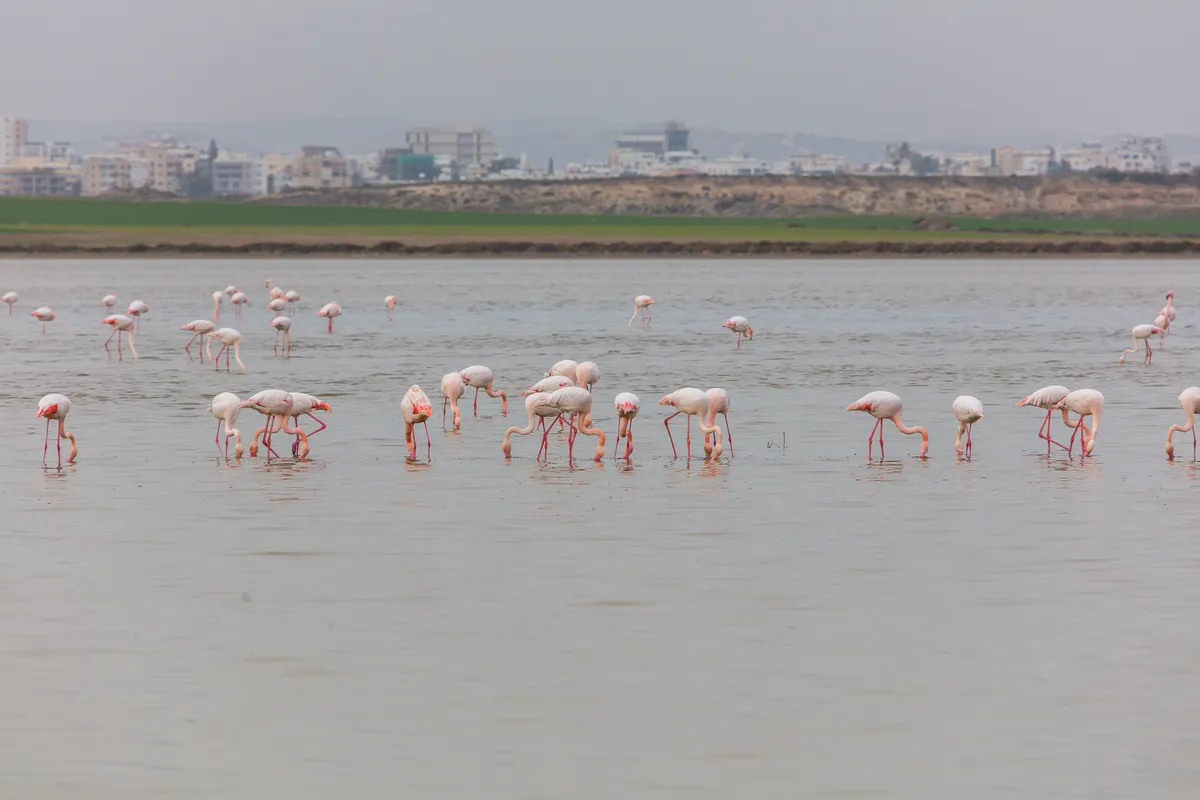
Greater flamingos winter on the salt lakes of Cyprus from about November to the end of February, and the 2026-27 season has started well: on 12 November 2026 the Cyprus Mail reported more than a thousand birds back at Akrotiri Salt Lake after the autumn rain, and Larnaca's first flocks had arrived about a month before that. The two places to see them are Larnaca Salt Lake, next to the airport, and Akrotiri Salt Lake near Limassol. Both are free. This guide compares them and explains how to watch without disturbing the birds.
When Is Flamingo Season in Cyprus?
BirdLife Cyprus describes the greater flamingo (Phoenicopterus roseus) as a winter visitor, usually arriving in November and leaving by the end of February. Those are typical dates, not fixed ones. Arrival depends on rain: the birds feed in shallow water, so they come when the lakes fill and move on when the water gets too deep or dries out. Some stay into spring, and in wet years a few have spent the summer.
Numbers swing widely from year to year, which is why you should be wary of any website promising a specific flock size.
| Count | Site and date | Source |
|---|---|---|
| 4,187 | Larnaca, December 2020 (monthly maximum) | LIFE IP Physis monitoring report |
| 1,554 | Larnaca, December 2021 (monthly maximum) | LIFE IP Physis monitoring report |
| 1,065 | Larnaca, winter 2025 waterbird survey | Cyprus Mail, February 2025 |
| About 30 | Akrotiri, January 2025, the lowest since monitoring began in 1992 | BirdLife Cyprus |
| More than 1,000 | Akrotiri, reported 12 November 2026 | Cyprus Mail |
The practical reading: December to February is the safest window, a wet autumn usually helps, and this winter has begun far better at Akrotiri than the last two.
Larnaca or Akrotiri: Which Should You Choose?
| Larnaca Salt Lake | Akrotiri Salt Lake | |
|---|---|---|
| Nearest town | Larnaca, beside the airport | Limassol, about 5 km to the south-west |
| Status | Ramsar site (since 2001) and Natura 2000 area | Ramsar site inside the British Western Sovereign Base Area |
| How you watch | A 4 km nature trail, a birdwatching tower, and the shore by Hala Sultan Tekke | An observation deck with telescopes at the environmental centre; pools along Lady's Mile |
| Cost | Free | Free |
| Best for | A short stop on arrival or departure day, or a walk from town | Seeing distant flocks through a telescope, with a beach afterwards |
| Watch out for | Birds can be far from the path; drone flights are restricted near the airport | The centre is listed as open weekday mornings only |
How Do You See Flamingos at Larnaca Salt Lake?
Larnaca Salt Lake is a chain of four lakes: the main lake, Alyki, plus Orphani, Soros and the small Airport Lake. A 4 km linear nature trail runs along the shore and ends at the Kamares aqueduct, and the main lake has a birdwatching tower on the path.
The classic viewpoint is the shore by Hala Sultan Tekke, the mosque on the western bank, where there is parking and a picnic area. The mosque itself is free to enter and is listed as open daily from 08:30 to 17:00 between 16 September and 15 April, although visitors are not admitted during Friday prayers. It is closed on Christmas Day and New Year's Day.
The flock moves between the lakes from day to day. If you see nothing from the mosque, walk a stretch of the trail or check the tower before giving up. For a slower visit with other wetland birds, our salt lake birdwatching page has more on the walk itself.
Without a car, the public transport visitor map shows several Larnaca city bus routes serving the salt lake, including route 429, which links the airport, the Tekke and the central station. Check the current timetable before relying on it. The lake pairs naturally with an afternoon in Larnaca and the Church of Saint Lazarus.
How Do You See Flamingos at Akrotiri Salt Lake?
Akrotiri is the largest wetland in Cyprus, a 2,171-hectare Ramsar site on the peninsula south-west of Limassol. It lies within the British Sovereign Base Area, so stick to public roads and signed viewpoints and stay away from military installations.
The easiest way in is the Akrotiri Environmental Education and Information Centre in Akrotiri village. Entry is free, and its observation deck has four telescopes trained on the lake, which matters here because the birds are usually a long way off. The official tourism listing gives the opening hours as Monday to Friday, 08:00 to 13:30, closed at weekends. Other websites quote longer hours, so go on a weekday morning to be safe.
Flamingos also feed in the pools behind Lady's Mile Beach, which you can scan from the road at any time, and there is a renovated hide overlooking Zakaki Marsh at the Limassol end, although reeds can block the view. Two Limassol bus routes, 19A and 24, run between Akrotiri village and the Leontiou station in town.
Combine the trip with Kolossi Castle or Ancient Kourion, both a short drive away.
Are There Other Places to See Flamingos?
Yes. BirdLife Cyprus lists Oroklini Lake, just north-east of Larnaca, and Paralimni Lake near Protaras among the sites where flamingos occur. Oroklini is the better equipped of the two, with an information kiosk and viewing platform on its north side and a birdwatching hide on the south. Visitors must stay outside the fence. It is also a good site for other waterbirds, including spur-winged lapwings.
What Are the Rules?
- Stay off the lake bed. At Larnaca, entering the protected habitat on foot or by vehicle is forbidden. Walking out for a closer photo can put the flock to flight, which costs the birds energy they need for winter.
- Leave the drone at home. Larnaca Salt Lake borders the airport. The Department of Civil Aviation bans drone flights outright in the inner airport zone and requires authorisation in the outer one, with heavy fines for violations. At Akrotiri, flying needs permission from the RAF station commander.
- Keep dogs on a lead and well back from the water's edge.
- Stay quiet and keep your distance. If the birds lift their heads and start walking away, you are too close.
Why Do Flamingos Come to Cyprus?
For the food. When winter rain floods the salt pans, a microscopic alga blooms in the brine and feeds huge numbers of tiny brine shrimp, chiefly Artemia salina. The shrimp are the flamingos' main food and the source of the pigments that turn their feathers pink.
The birds are travellers from across the Mediterranean and beyond. Rings read on flamingos in Cyprus have come from Iran, Turkey, Algeria, Sardinia, Spain, Morocco, Azerbaijan, France and Egypt, according to BirdLife Cyprus. They have tried to nest here too: about 200 nesting mounds were recorded at Akrotiri in summer 2020 before the colony abandoned them.
Are the Flamingos Under Threat?
The lakes are protected, but the pressure is real. In 2020, laboratory tests confirmed that 85 flamingos found dead at Larnaca had died of lead poisoning from old shotgun pellets in the lake sediment. At Akrotiri, BirdLife Cyprus has campaigned against development around Zakaki Marsh, and in December 2025 it called for an investigation after the wetland's condition deteriorated and tests found elevated bacteria levels at some sampling points.
With pressures like these, the least a visitor can do is keep disturbance to a minimum, which is what the rules above are for.
What Should You Bring, and When Should You Go?
BirdLife Cyprus recommends early morning or late afternoon for birdwatching in general, and those hours also give the softest light on the water. Bring binoculars or a small telescope. For photographs you will want a long lens; a phone will mostly record pink dots.
Winter days are mild but the lake shores are open and can be windy, so pack a layer. Our best time to visit Cyprus guide has month-by-month weather, and our airport transfers guide covers getting between Larnaca airport and the rest of the island.
Frequently Asked Questions
What is the best month to see flamingos in Cyprus?
December, January and February are the most reliable. Birds usually arrive in November and leave by the end of February, but timing follows the rain.
Are there flamingos in Cyprus right now?
Yes. As of mid-November 2026, local media reported more than a thousand flamingos at Akrotiri Salt Lake and flocks at Larnaca Salt Lake.
Is it free to see the flamingos at Larnaca Salt Lake?
Yes. The nature trail and viewpoints are open access, and the Hala Sultan Tekke mosque on the shore is free to enter.
How close can you get to the flamingos?
Not very. They feed out in the shallows and you must stay on the paths, so binoculars or a telescope make a big difference. Akrotiri's environmental centre has telescopes on its observation deck.
Can you see flamingos in Cyprus in summer?
Usually not. The lakes mostly dry to a salt crust in summer, although a few birds have stayed in wetter years.
Can you fly a drone at Larnaca Salt Lake?
No, not without checking the official airport geo-zone map first. The lake lies beside Larnaca Airport, where drone flights are banned in the inner zone and need authorisation in the outer zone.
About the author
Alex Borshch
Keep reading
Related articles
Get On The Newsletter Waitlist
The Cyprus 365 newsletter has not started yet. Join the waitlist to hear when it does, with new guides and updates on the south of Cyprus.