Cyprus With Kids: A Practical Family Travel Guide
Cyprus with kids: shallow Blue Flag beaches, three waterparks, zoos, boat trips and Troodos day plans, plus the car seat law and health tips families need.
Cyprus works well for a family holiday because the things children need most sit close together. Beaches shelve gently into warm, clear water, the south of the island is small enough that nothing is more than a couple of hours away, and English is spoken everywhere. This guide covers the calm beaches, waterparks, zoos and boat trips, ruins that hold a child's attention, Troodos with young ones in tow, rainy-day backups, and the practical details on car seats, sun and health.
Where to base yourself
The best family base depends on your children's age and how much you plan to drive. Protaras and Ayia Napa have the gentlest beaches and two of the three waterparks within reach. Paphos pairs sandy bays with walkable ruins and its own waterpark. Larnaca sits next to the main airport, suiting short stays.
- Youngest children, beach-focused: Protaras, for shallow water and a short walk to everything.
- Mixed ages, beach plus sightseeing: Paphos, where the seafront and ancient sites sit close together.
- Short trip or late flight: Larnaca, a few minutes from the airport with a long promenade.
- Cooler escape in summer: the Troodos mountains, several degrees cooler than the coast.
Distances matter more with children in the car than for adults alone. Count on roughly 1.5 to 2 hours to cross from one coast to the other (Paphos to Limassol is about 90 km, Limassol to Protaras a little over an hour), and a bit over 2 hours from Troodos to the east coast. Most families do better splitting a week between two bases, for example a beach stretch followed by a few nights in Paphos, with day trips filling the gaps.
The calmest beaches for children
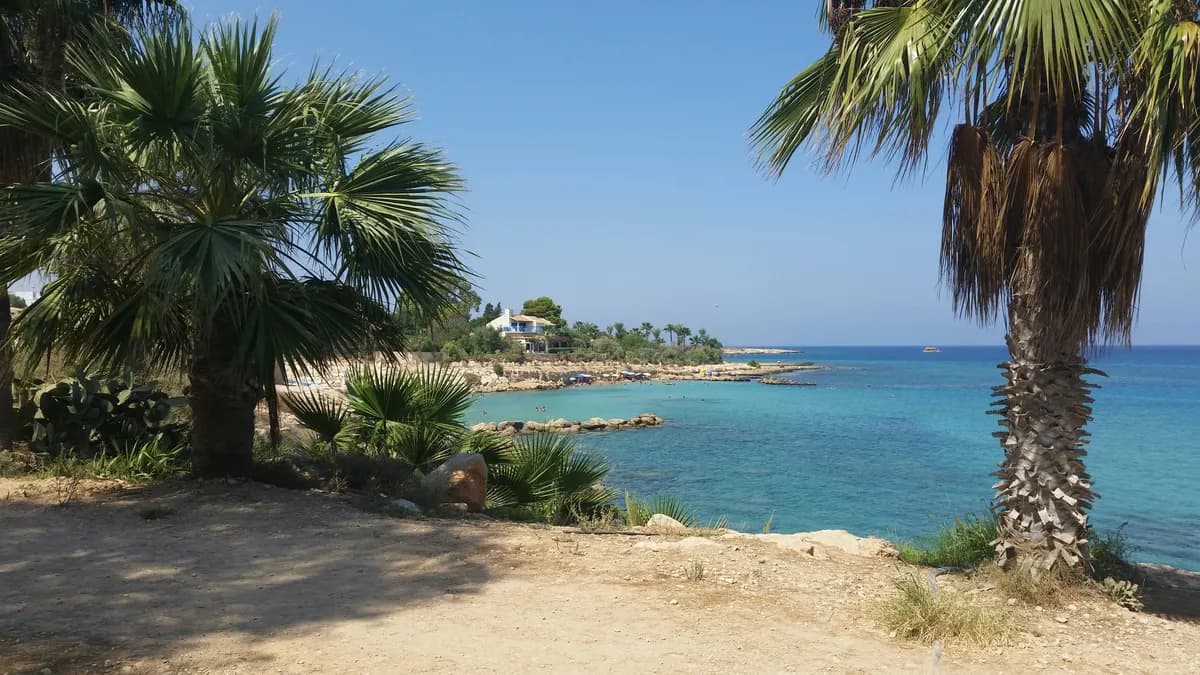
Two beaches stand out for families and both hold Blue Flag status, signalling clean water, lifeguards and safety equipment in season. Fig Tree Bay at Protaras has soft sand, a gradual entry and water shallow enough for small children to wade a long way out, with a small islet just offshore that confident swimmers reach by a short swim on a calm day. On the west coast, Coral Bay sits in a sheltered horseshoe with the same easy entry and sunbeds backed by cafes.
A few more bays suit families. Makronissos Beach near Ayia Napa is a string of small protected coves with calm water, and Finikoudes Beach in Larnaca runs alongside a palm-lined promenade for a beach day and an ice cream stroll. Lifeguards staff the main beaches from April to October.
Whatever beach you pick, treat the sun seriously. In June and July the UV index around midday is routinely extreme and unprotected skin can burn quickly, so plan the strongest sun (roughly 10am to 3pm) around shade or lunch. Bring a parasol or beach tent (except at Lara, where umbrellas and tents are banned from June to September), reapply sunscreen often, and pack a hat for every child. Water shoes save small feet on hot sand and the occasional rocky patch.
Waterparks worth the day
Cyprus has three sizeable waterparks, one on each side of the island, so a family based almost anywhere is within reach of one. WaterWorld in Ayia Napa is the best known, billed as Europe's largest themed waterpark and built around an ancient Greek mythology theme with rides from gentle children's pools up to steep drops for teenagers. It runs daily, roughly 10am to 5pm in the shoulder months and 10am to 6pm from June to August, tickets around EUR 50 adult and EUR 30 child aged 3 to 12, often with a second-visit offer worth checking.
Limassol's option is Fasouri Watermania, west of the city near Kolossi, open May to October with 30 different slides and attractions, one of Europe's larger wave pools, a lazy river about 400 metres long said to be the biggest in Cyprus, and a children's pool that stays knee-deep throughout. Entry runs around EUR 30 over 12 and EUR 17 for a child. Supervision rules are strict: under-12s need an accompanying adult, under-8s must be supervised at all times, and children aged five and under need an adult within three metres of them in the water.
Paphos has Aphrodite Waterpark, the biggest in the region, open from spring into early November with hours shifting by month. Prices start from around EUR 20 for a child and EUR 36 for an adult, and a family ticket for two adults and three children runs from around EUR 115. Arrive close to opening for shaded loungers, and check the operator's site for the day's hours since all three parks vary.
Zoos and animal days
For a change of pace from sand and slides, Cyprus has three solid animal attractions across the south. Pafos Zoo is open daily year-round from 9am, closing anywhere from 5pm in winter to 7pm in August, and charges around EUR 19 to 20 adult and EUR 12 to 13 child, with parrot and owl shows at its amphitheatre. Near Larnaca, Camel Park in Mazotos is the only camel park on the island, home to more than 100 animals including camels, ostriches and ponies. Limassol Zoo, rebuilt inside Limassol Municipal Park, is the budget option: adult entry around EUR 5, children around EUR 2, with keeper-led feeding sessions.
Boat trips and turtle watching
Boat trips are a hit with children who tire of sitting still on a beach. From Protaras Pier or Paralimni Marina, a glass-bottom boat sails several times a day so children watch marine life without getting wet, from around EUR 20 adult and EUR 10 child, up to EUR 25 and EUR 15 for a longer sailing. From Ayia Napa harbour, the pirate-themed Black Pearl cruise is a fuller morning out, roughly four hours with swim stops and lunch included, for around EUR 45 adult and EUR 25 child. Both leave from points walkable for a family based in Ayia Napa or Protaras.
Between roughly May and September, loggerhead and green turtles nest at Lara Beach on the Akamas peninsula near Paphos, with hatchlings mostly emerging in August and September. There is no organised night-watch tour, so treat turtle watching at Lara as a possible bonus rather than a booked activity: with good timing you may spot roped-off nests or, rarely, hatchlings crossing the sand. Lara has no shops, shade or toilets, and the last stretch needs a sturdy vehicle. From 1 June to 30 September umbrellas, tents and sunbeds are banned there and the beach is closed from an hour before sunset, so plan a short daytime visit. The flamingos at Larnaca Salt Lake draw winter visitors, roughly November to March.
Ruins that work with short attention spans
Cyprus has serious archaeology, and a few sites hold children's interest because there is space to roam and something visual to look at. Keep visits short, go early before the heat, and pick sites with a clear story or a striking feature.
- Ancient Kourion near Limassol has a Greco-Roman theatre carved into a cliff above the sea, an easy shape for children to grasp, with mosaics nearby.
- Kolossi Castle is a compact medieval tower you can climb to the roof, small enough to explore in half an hour.
- Paphos Archaeological Park has flat paths between covered mosaic houses, so the going underfoot is easier than at most ruins.
- Tombs of the Kings lets children walk down into underground courtyards cut from rock, which feels like an adventure, though the ground is uneven.
Aphrodite's Rock on the Paphos to Limassol road makes a quick photo and paddle stop tied to a memorable myth, and Omodos village in the Troodos foothills has a cobbled square, a monastery and space to run around.
Troodos with kids
The mountains are worth a day even with young children, mostly for the drop in temperature and space to run around rather than hiking distance. Near the summit of Mount Olympus there is an easy, largely flat circular walk for young legs, well short of the longer routes serious hikers take. Troodos village square has a proper playground under the pines, ringed by cafes and restrooms. Near Pano Platres, the walk to Millomeris Waterfall is short and manageable, about 20 minutes each way from a car park with a toilet and cafe; the tougher Caledonia Falls trail beyond it suits older children. Snow is possible in winter, a genuine novelty worth checking conditions for.
Rainy or too-hot day options
Cyprus is dry most of the year, but a cool indoor stop still helps on a scorching August afternoon or a wet spell in winter. The Fairytale Museum in Nicosia's old town, near Paphos Gate, is a genuine child-oriented museum with storytelling and workshops; entry runs around EUR 5, under-4s free, hours vary by season. Nicosia, Limassol and Larnaca also have indoor soft-play and trampoline venues for an overheated afternoon.
Driving and getting around
A hire car is the practical way to travel as a family, letting you reach beaches and sites on your own timetable and carry beach gear. Cyprus drives on the LEFT, the same as the UK, familiar to British visitors and worth a moment's thought for everyone else. Roads are generally good, though Troodos hill roads are narrower and slower than coastal motorways.
Child car seats are a legal requirement. Under the Road Safety Law (174/1986, Article 15), a child shorter than 150 cm must travel in an approved restraint suited to the child's size and weight and fitted to the manufacturer's instructions. From 135 cm the law allows the adult belt in a rear seat of a car with belts fitted throughout, though a well-fitting approved booster is still the safer choice. A rear-facing seat must never be used in front of an active airbag, and Road Safety Cyprus publishes the current approval standards and the rules on young children in the front seat. Driving a child without the correct restraint carries a fixed penalty of EUR 150 plus three to six penalty points, doubled for a repeat offence within three years. Most hire companies rent seats, but book ahead since stock is limited in peak season, and bringing a seat you trust from home is often the surest option.
Health, heat and practical tips
Cyprus is an EU member and the standard of care is good. The single emergency number is 112, and operators speak English. EU and UK visitors should carry a valid EHIC or GHIC for state healthcare, alongside travel insurance, which covers private clinics and repatriation that the card does not. There is no permanent 24-hour pharmacy, but a rotating duty system guarantees one open every night in every region, until roughly 10pm in winter and 11pm in summer, posted on every closed pharmacy's door.
Tap water across the south meets EU drinking-water standards and is officially safe to drink, though the taste leads some residents to prefer filtered or bottled water; many parents use bottled water for infant formula as a precaution. Summer afternoons are hot enough to wilt small children, so build the day around a cool middle, treating 10am to 3pm as the window to avoid. The currency is the EURO, and plugs are type G, the UK three-pin, at 230 to 240 volts.
| Need | Family tip |
|---|---|
| Sun | Beach in the morning and late afternoon; rest or eat indoors between 10am and 3pm. |
| Water | Tap water is safe across the south; carry refillable bottles to avoid dehydration. |
| Food | A souvla grill plate or grilled halloumi suits most children; meze lets fussy eaters pick. |
| Stroller | Old-town lanes and ruins are uneven; a carrier beats wheels at archaeological sites. |
| Money | Cards are accepted widely; keep some EUR cash for small beach kiosks and village cafes. |
Local food is easy with children. Halloumi appears at almost every meal, loukoumades are warm honey doughnuts that win over most kids, and kleftiko lamb suits younger eaters. Most tavernas are relaxed about children, and some places, such as Pelican Restaurant, have a dedicated kids menu.
Sample family day plans
A beach-and-waterpark base might run: a slow morning on the sand before the sun peaks, then an afternoon at the waterpark once the worst heat has passed. A Paphos-based day could pair an early morning at the archaeological park with an afternoon swim, leaving the zoo for another day. For a cooler change of scene, drive up to Troodos for a walk and playground time before heading back down. Spacing one bigger outing every other day keeps energy levels steady.
Frequently Asked Questions
Which part of Cyprus is best for families with young children?
The east coast around Protaras and Ayia Napa is generally easiest, thanks to shallow, gently shelving beaches and easy access to WaterWorld. Paphos suits families who want to mix beach time with ruins, while Larnaca works well for short stays close to the airport.
Which waterpark should we choose?
Choose the one closest to your base. WaterWorld in Ayia Napa is the best known and bills itself as Europe's largest themed waterpark, Fasouri Watermania near Limassol is the largest park in Cyprus by area and has the biggest lazy river, and Aphrodite Waterpark is the most convenient if you are staying in Paphos. All three have dedicated toddler pools.
Is a car seat required by law in Cyprus?
Yes. A child shorter than 150 cm must use an approved restraint suited to their size and weight; from 135 cm the law allows the adult belt in a rear seat of a car with belts fitted throughout, though an approved booster remains the safer option. Road Safety Cyprus sets out the rules on young children in the front seat and the approval standards that count. The fixed penalty for not using the correct seat is EUR 150 plus three to six penalty points, and it doubles for a repeat offence within three years.
Can we get by without a rental car?
It is possible if you stay entirely on the east coast, since Protaras Pier, Ayia Napa harbour and several beaches are walkable, and boat trips leave on foot. Reaching Troodos, Lara Beach or the far side of the island without a car is much harder.
Is the tap water safe for children to drink?
Yes, municipal tap water across the south of Cyprus meets EU drinking-water standards and is officially safe. Many residents still prefer filtered or bottled water for taste, and some parents use bottled water for making up infant formula, but this is a personal precaution rather than a sign the tap supply is unsafe.
What should we do about the midday sun with young children?
Treat roughly 10am to 3pm as the window to avoid direct sun, especially in June and July when the UV index is routinely extreme. Plan beach time for the morning or after mid-afternoon, use a beach tent where allowed (not at the Lara turtle reserve in summer), and reapply sunscreen often.
Are there good rainy or too-hot indoor options?
Yes. The Fairytale Museum in Nicosia's old town is a genuine child-oriented museum with storytelling, themed exhibitions and workshops, and entry runs around EUR 5. Nicosia, Limassol and Larnaca also have indoor soft-play and trampoline venues that work well for an overheated afternoon or an unexpected wet spell in winter.
Can we realistically see turtles at Lara Beach?
You might, but it is not a guaranteed or bookable experience. Loggerhead and green turtles nest at Lara roughly from May to September, with hatchlings mostly emerging in August and September, and there is no organised night-watch tour, so any sighting comes down to timing and luck rather than a booked activity.
Protaras
This guide covers Protaras. Explore more about this destination.
View DestinationAbout the Author
Alex Borshch
Founder and editor of the Isla365 network. Spent six months living in the Dominican Republic over the 2013-14 winter, and has since wintered in Thailand, Vietnam and Turkey. Writes and edits the guides across the network.