Best Beaches in Cyprus: An Honest Coast Guide
Best beaches in Cyprus by area: Ayia Napa and Protaras white sand, Paphos coves, wild Akamas, plus Limassol and Larnaca's walkable town shores.
How to think about Cyprus beaches
Cyprus packs a lot of coastline into a small island, and the beaches are genuinely varied. The east around Ayia Napa and Protaras has the soft white sand and shallow turquoise water that fills the postcards. The west around Paphos mixes family-friendly sand with rocky coves and the undeveloped wilderness of the Akamas peninsula. Limassol and Larnaca have long urban beaches you can walk to from your hotel. Knowing the differences saves you a wasted drive.
One reliable signal of quality is the Blue Flag, which certifies water quality, safety, facilities and environmental management. Cyprus earns a high number of these awards relative to its small size. For the 2026 season the south of the island was awarded Blue Flags at 56 beaches plus two marinas. A Blue Flag does not mean a beach is beautiful, it means it is clean, monitored and well run, so treat it as a baseline for families rather than a beauty contest.
What the colours and signs mean
Most organised beaches fly coloured flags. Red-and-yellow flags mark a lifeguarded swimming zone, yellow means swim with care, and red means stay out of the water. The absence of a warning flag is not a guarantee of safe conditions, so follow each beach's own signs and lifeguards. Many beaches have lifeguards in high season (roughly mid-May to October), but cover is not guaranteed out of season. Cyprus drives on the left, and beach car parks are usually free or a few euros, so a hire car opens up the quieter spots that buses skip.
Ayia Napa and Protaras: the white-sand east
This corner has the best swimming sand on the island and the busiest summer crowds. If you want soft sand, warm shallow water and full facilities, start here.
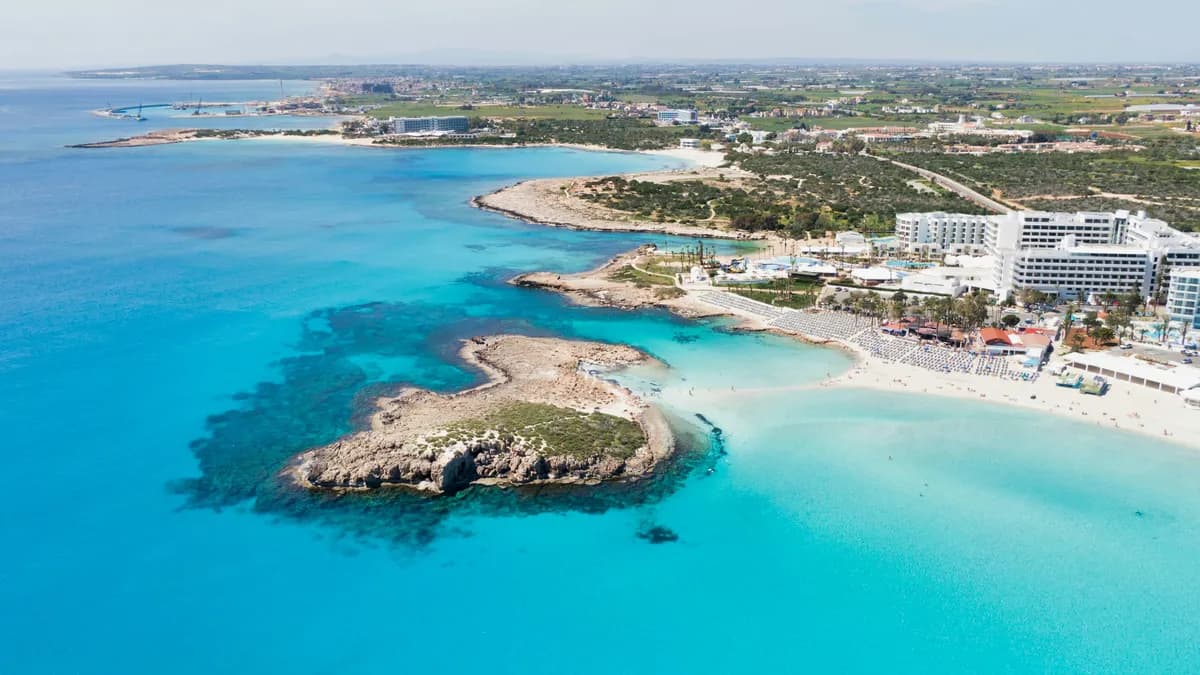
- Nissi Beach is the famous one: a wide arc of pale sand with a small sandbar islet you can wade to. It is Blue Flag, fully organised with sunbeds, watersports and bars, and it gets loud and packed in July and August. Best for young crowds and those who want everything on tap.
- Makronissos Beach sits a short drive west of central Ayia Napa and has the same powdery sand with a calmer feel and gentle shelving water. Good for families who like Nissi's looks without the volume.
- Landa Beach lies between Nissi and Makronissos and is the quietest of the three, with fine sand, shallow water and enough loungers that they are rarely all taken.
- Konnos Bay, between Ayia Napa and Protaras inside the Cape Greco forest park, is a sheltered cove framed by pine-covered cliffs. The water is calm and clear, which makes it one of the better spots for snorkelling and paddleboarding. Go in the morning before it fills.
- Fig Tree Bay in Protaras is the family favourite: Blue Flag, organised, with a small island offshore and water shallow enough for small children to wade a long way out.
- Sunrise Beach in Protaras is another organised, family-grade option, with watersports and an easy, gradual entry.
The whole headland of Cape Greco is worth the trip for its sea caves and clear water (cliff jumping at the Sea Caves is now fenced off by the Forestry Department because the rock is unstable, so respect the barriers and signs), and you can reach the bays from the sea on a Cape Greco boat cruise. Adrenaline-minded visitors can add Protaras watersports or the rides at WaterWorld waterpark.
Paphos and Coral Bay: sand, coves and the wild west
The Paphos coast is more mixed. Town beaches lean rocky, so most beachgoers head north to Coral Bay or south to the mythic landmark at Petra tou Romiou.
- Coral Bay is the main sandy resort beach north of Paphos: a sheltered, crescent-shaped bay with golden sand, gentle water and full facilities. It is the most family-friendly stretch in the west.
- Petra tou Romiou, the birthplace of Aphrodite in myth, is a dramatic pebble-and-sand beach around a sea stack on the Paphos-Limassol road. The pebbles make entry harder and the water can be choppy, so it suits sightseers and strong swimmers more than families with toddlers. The landmark itself, Aphrodite's Rock, is the reason most people stop.
- Lara Beach in the Akamas is the wild one. It is a protected nesting site for loggerhead and green turtles, so it is left completely natural: no sunbeds, no bars, no toilets and almost no shade. Reaching it needs a rough track or a tour. Bring your own water and sun protection, take everything away with you, and keep to the rules during nesting season (roughly May to September).
- Blue Lagoon at the tip of the Akamas is not a sand beach but a swimming spot reached mostly by boat, with clear, calm turquoise water over rock.
The Akamas rewards a full day out. You can hike the Avakas Gorge, start a walk at the Baths of Aphrodite near Polis and Latchi, take an Akamas jeep safari or join a Blue Lagoon boat cruise. Responsible visitors can learn about turtle watching at Lara through the conservation station rather than disturbing the nests.
Limassol: long city beaches
Limassol's coast is mostly dark sand and pebble, less photogenic than the east but easy to reach on foot from the city and well served by tavernas.
- Lady's Mile Beach is a long, flat, shallow strip south of the port near the salt lake. The very gradual shelving makes it safe for small children, and the length means there is always space, though the sand is firm and grey rather than white.
- Governor's Beach, east of the city, is a string of small coves with white limestone rock and dark sand. The clear, sheltered water and rock formations make it one of the better snorkelling spots on this stretch.
Beach days here pair naturally with Limassol's other draws: the seafront Limassol Castle, nearby Ancient Kourion above the sea, Kolossi Castle, and a wine villages tour into the foothills. Time your visit for the Limassol Wine Festival in late summer if you can.
Larnaca: walkable town sand
Larnaca's beaches are the most convenient if you are arriving through the main airport and want sea within a short walk.
- Finikoudes Beach runs along a palm-lined promenade in the centre of town, backed by cafes and restaurants. The sand is fine and grey-gold, the water shallow, and the setting urban rather than wild, but for a stroll-from-your-hotel swim it is hard to beat.
- Mackenzie Beach sits next to the airport runway, which sounds odd but means low-flying planes overhead and a lively row of beach bars and fish tavernas. It is the social, sundowner end of the Larnaca coast.
Out of season, Larnaca has a second act inland at the Larnaca Salt Lake, where flamingos gather in winter. Combine a town beach day with the Church of Saint Lazarus and, in the cooler months, flamingo birdwatching. Divers come to Larnaca above all for the Zenobia wreck, one of the best wreck dives in the Mediterranean.
Quick comparison
| Beach | Area | Sand type | Best for |
|---|---|---|---|
| Nissi Beach | Ayia Napa | White, soft | Young crowds, full facilities |
| Fig Tree Bay | Protaras | White, soft | Families, shallow water |
| Konnos Bay | Cape Greco | Soft, sheltered | Snorkelling, calm mornings |
| Coral Bay | Paphos | Golden | Families in the west |
| Lara Beach | Akamas | Natural, no facilities | Seclusion, turtle nesting |
| Lady's Mile | Limassol | Firm, grey | Long, safe, uncrowded |
| Finikoudes | Larnaca | Grey-gold | Walkable town swim |
Seasons at a glance
| Signal | Timing | Notes |
|---|---|---|
| Swimming season | June to October (warmest) | May and late October are still comfortable, with far thinner crowds. |
| Lifeguard cover | Roughly mid-May to October | Not guaranteed outside this window; heed flag colours regardless. |
| Turtle nesting, Lara Beach | Roughly May to September | Loggerhead and green turtles nest; keep to marked paths and never disturb a nest. |
| Blue Flag beaches | 2026 season | 56 beaches plus 2 marinas awarded in the south. |
Practical notes
- Currency is the euro. Sunbed-and-umbrella sets on organised beaches typically run a modest daily fee paid to the kiosk; bring small cash.
- The sea is warmest from June to October. May and late October still give comfortable swimming with far thinner crowds.
- The emergency number is 112. Heed the flag colours and swim near lifeguards where they are posted.
- On protected beaches like Lara, take all litter away, do not drive on the sand, and never disturb a turtle nest. English is widely spoken, so asking locals for the current state of a beach is easy.
If you want one of everything, base yourself centrally and day-trip: the white sand of the east, the coves and wilderness of Paphos and the Akamas, and the walkable town beaches of Limassol and Larnaca are all within a few hours' drive of each other.
Frequently Asked Questions
What is the best beach in Cyprus?
There is no single best beach because Cyprus beaches suit different trips. Nissi Beach in Ayia Napa is the most famous, with pale sand and a wadeable sandbar islet, but it gets loud and packed in July and August. Fig Tree Bay in Protaras is the strongest all-round pick for families, with Blue Flag status and shallow water. Coral Bay covers the same family role in the west near Paphos.
Which Cyprus beaches are best for families with small children?
Look for gradual, shallow entry. Fig Tree Bay in Protaras and Makronissos Beach near Ayia Napa both shelve gently and are calmer than Nissi. Coral Bay north of Paphos is the most family-friendly stretch in the west, with full facilities. Lady's Mile near Limassol also shelves very gradually, which makes it safe for small children even though the sand is firmer and grey rather than white.
What does a Blue Flag mean at a Cyprus beach?
A Blue Flag certifies water quality, safety, facilities and environmental management, not scenic beauty. For the 2026 season, the south of Cyprus was awarded Blue Flags at 56 beaches plus two marinas, a high number for the island's size. Treat a Blue Flag as a baseline of cleanliness and organization for families rather than a guarantee that a beach is the prettiest one around.
When is the best time to visit Cyprus beaches?
The sea is warmest from June to October, which is the core swimming season. May and late October are still comfortable for swimming and come with far thinner crowds than peak summer. Lifeguard cover generally runs from mid-May to October but is not guaranteed outside that window, so check flag colours regardless of when you visit.
What do the flag colours mean on Cyprus beaches?
Most organised beaches fly a coloured flag system. Red-and-yellow flags mark the area watched by lifeguards, yellow means swim with care, and red means do not enter the water. No flag does not mean the sea is safe, so check local signs and ask the lifeguard. Lifeguards are posted at many organised beaches in high season, roughly mid-May to October, but cover thins or disappears outside that period, so the flag colour matters even more in shoulder months.
Do you need a car to reach the best beaches in Cyprus?
A hire car is not essential for the main resort beaches near Ayia Napa, Protaras, Limassol or Larnaca, which are close to hotels and served by local transport. It becomes far more useful for reaching quieter or wilder spots such as Lara Beach or the Blue Lagoon in the Akamas, or for exploring Cape Greco. Cyprus drives on the left, and beach car parks are usually free or a few euros.
Is Lara Beach in the Akamas worth visiting?
Yes, if you want a genuinely wild beach rather than an organised one. Lara Beach is a protected nesting site for loggerhead and green turtles, roughly May to September, so it is left natural with no sunbeds, bars, toilets or shade, and reaching it needs a rough track or a tour. Bring your own water and sun protection, take all litter away, and keep to marked paths.
Which Cyprus beaches are good for snorkelling?
Konnos Bay, a sheltered cove inside the Cape Greco forest park between Ayia Napa and Protaras, has calm, clear water that makes it one of the better spots for snorkelling and paddleboarding, especially in the morning before it fills up. Governor's Beach east of Limassol also has clear, sheltered water around white limestone rock formations that suits snorkelling.
Ayia Napa
This guide covers Ayia Napa. Explore more about this destination.
View DestinationAbout the Author
Alex Borshch
Founder and editor of the Isla365 network. Spent six months living in the Dominican Republic over the 2013-14 winter, and has since wintered in Thailand, Vietnam and Turkey. Writes and edits the guides across the network.